NOTES Dry fly fishing
Rising Trout and Dry Fly Fishing: A Bariloche Guide
A rise is the beginning of an observation, not a signal to cast immediately.
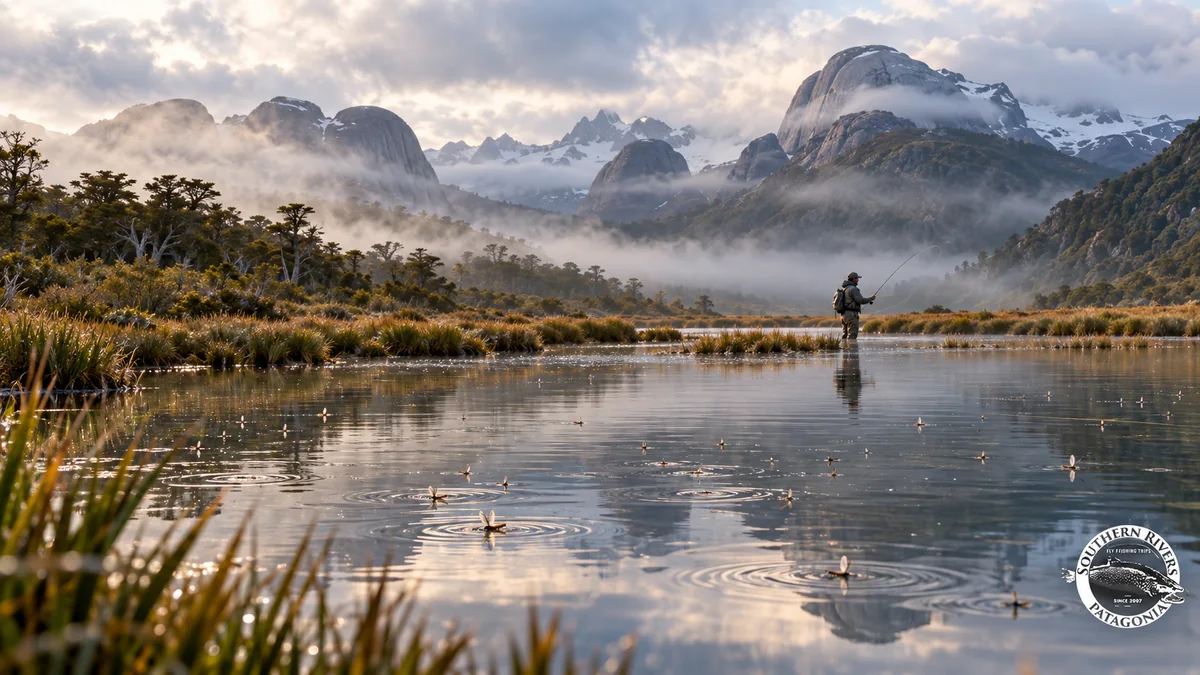
Seeing a trout disturb the surface is one of the most engaging moments in fly fishing. It gives you something to watch and a possible target for the next presentation. During guided fishing around Bariloche, your guide can help turn that excitement into a plan. The first useful action is often to pause. A few observations about position, rhythm and current can tell you more than several hurried casts made before you understand what the fish is doing.
Locate the feeding lane rather than the last splash
A ring on the surface is a clue, but its position changes as the current carries it downstream. Watch where the disturbance begins and use a fixed reference on the bank to remember the area. If the fish rises again, compare the position. You are trying to understand the feeding lane rather than casting at a circle that has already moved away.
Your guide may ask you to wait for another observation before presenting a fly. That pause can reveal whether the trout is feeding repeatedly in one place or moving through the area. The note about reading river water explains why seams and changes in current matter. A clear target begins with seeing how the fish relates to the water around it.
Look for food without making identification a test
Notice insects on the surface, along the edge or in the air, and let the guide connect those observations with the rise. A disturbance does not always mean a trout is taking a fully floating adult insect. Feeding close to the surface can create clues that require a different presentation from the one you first imagined.
You do not need to identify every insect before enjoying dry fly fishing. Ask what the guide is trying to imitate and which feature matters most in the chosen pattern. Our guide to fly types for Patagonia separates the roles of dry flies, nymphs and streamers. That broader understanding helps explain a change of method when surface activity does not match the original plan.
Plan where the fly should land and drift
Think about how the fly will reach the feeding lane. Dropping it directly onto the last rise can disturb the water and leave little time for a natural presentation. Your guide can identify a suitable landing point and angle, taking account of the current between you and the fish. The cast starts a drift; it is not the whole encounter.
Watch for the line pulling the fly faster or sideways compared with nearby floating material. If the presentation is being dragged, repeated casts with the same arrangement may simply repeat the problem. The note on mending and line control describes ways to understand that movement. Sometimes a change in position or a shorter cast is more useful than changing the fly.
Keep the fly in view and the response unhurried
Tell your guide if you cannot locate the fly after it lands. Losing sight of it makes the rest of the presentation difficult to interpret. The guide can help with a clearer reference, a manageable distance or a pattern you can follow more easily. Trying to fish farther away is rarely the first answer when the basic problem is seeing the drift.
Discuss what to do when a trout takes the fly before it happens. That brief explanation reduces the chance of reacting to every splash without knowing whether it involved your presentation. If a fish rises near the fly but is not hooked, pause and look again. One missed opportunity is not proof that the fish has left or that every part of the setup needs replacing.
Let surface activity shape part of the fishing day
Dry fly opportunities depend on the water and the conditions. A trip cannot promise a particular hatch or continuous rising fish. If surface activity stops, your guide may suggest another stretch or method while keeping an eye on the water. That flexibility can make the overall day more interesting than waiting indefinitely for a scene to repeat.
Tell Southern Rivers Patagonia if dry fly fishing is a priority when arranging your private guided trip. A useful day can include learning to spot a rise, recognise the feeding lane and plan a controlled presentation. These observations make surface fishing more understandable and enjoyable, even when each opportunity asks for patience.